After (very) early growing pains, Leafs’ Gavin McKenna has come alive

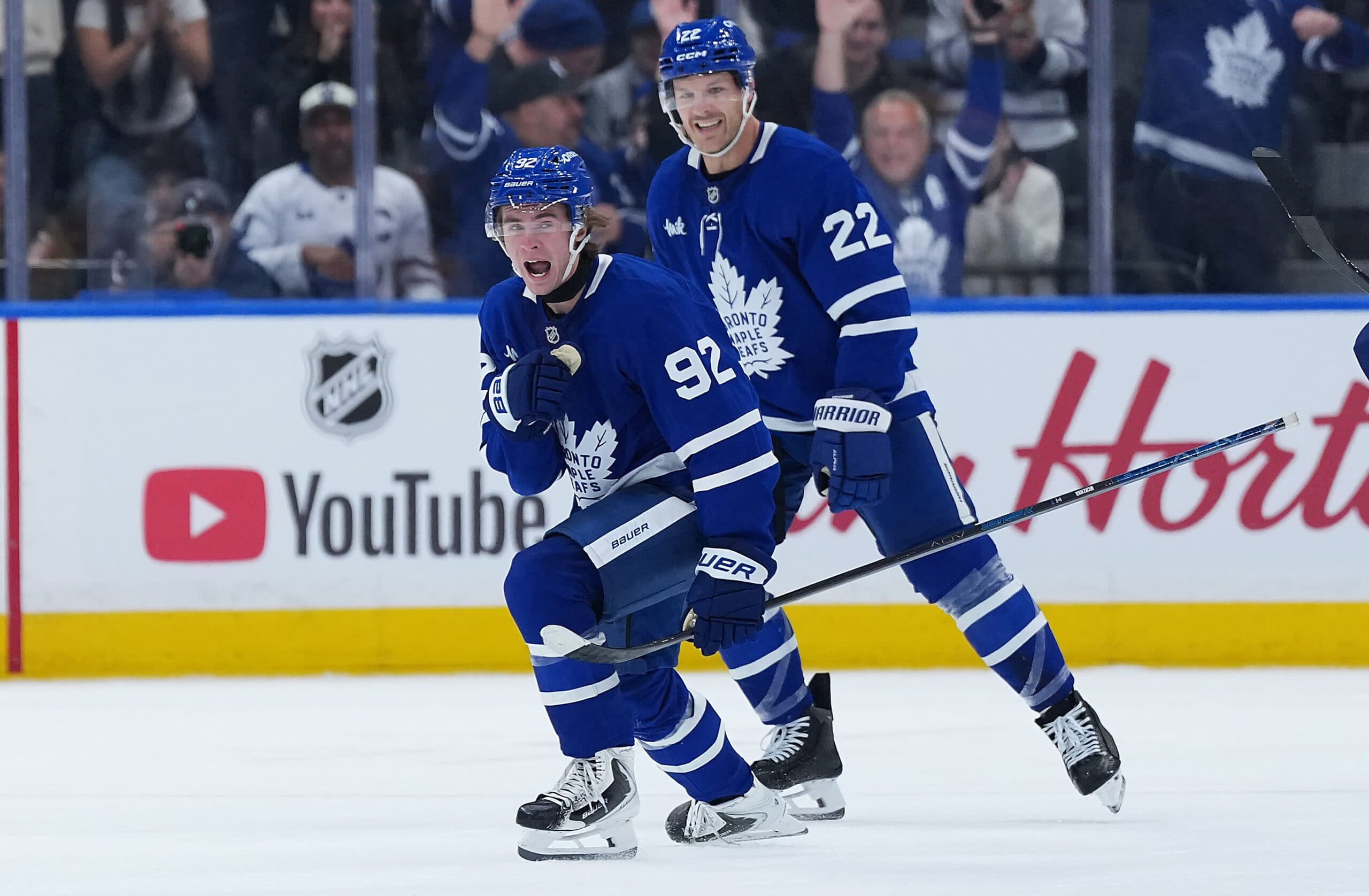
Toronto Maple Leafs forward Gavin McKenna heard all the detractors. He even called his “Welcome to the NHL” moment hearing from the media that he hadn’t registered a point through three games.
But everything changed on Tuesday night against the Nashville Predators.
McKenna recorded the first point of his career with a primary assist on John Tavares’ goal. Then, with under five minutes to go in the middle stanza, McKenna scored to send Scotiabank Arena into a frenzy unlike anything we’ve seen in recent memory. He even had an excellent screen on Toronto’s second goal, despite it not getting him onto the scoresheet.
It was a near-perfect game for McKenna, who, at one point, was dropped off Toronto’s second line as coach Jim Hiller experimented to get his team to wake up. And, ultimately, McKenna was a big reason why the Leafs were able to battle for the victory.
“Even after that first assist, it was a special moment,” McKenna said Tuesday night. “Really felt it from the fans… It was special.”
Expectations were high for the reigning No. 1 pick in the NHL Draft. McKenna’s name has been in the hockey lexicon for about half a decade, and after overcoming some early draft-year struggles, he ultimately made a strong enough case to go first overall.
But after all the buzz, McKenna failed to register a point through his first three games. For reference, Macklin Celebrini and Connor Bedard registered their first points in their debut efforts. The same goes for McKenna’s Toronto teammates, John Tavares and Auston Matthews (who had four goals in his debut). Some others took a bit longer – Juraj Slafkovsky (five games) and Jack Hughes (seven) notably struggled out of the gate. Steven Stamkos seemed like a bust because it took him eight games to figure it out.
So, a slow start isn’t unusual for a top prospect. It’s difficult for an 18-year-old to make the jump to the biggest league in the world and find the same success they did in college or major junior.
The creativity had been there, but the results hadn’t prior to Tuesday. Heading into that night, some fans had screamed to have McKenna demoted to the bottom six or even the AHL. Fair to say those concerns have been put to rest, right?
In the end, we’re talking about an 18-year-old four games into his NHL career. Nobody realistically expected him to light up the league at this point. Growing pains were absolutely to be expected. San Jose Sharks first-rounder Ivar Stenberg hasn’t exactly decimated goalies so far, despite being better in the early going. He also entered the year with 68 games of pro hockey experience in the SHL, one of the toughest leagues for a young player to thrive in. Again: the NHL is a damn hard league to adjust to.
Has McKenna been perfect? Obviously not. His off-puck play has been criticized, as well. That’s nothing new; his lack of urgency has been a sticking point for scouts for years now. He’s not exactly capable of mowing guys down, either. That’s something the Leafs’ coaching staff will continue to focus on.
“It’s just been a process every game, just trying to nitpick things and learn from each play and each shift,” McKenna said on Tuesday. “Obviously, there’s still things to be learned, and it’s going to start to come.”
McKenna said he has worked on getting more to the middle of the ice compared to his college days, but he knows it’s still a work in progress. There’s a legit argument that McKenna doesn’t get the puck enough alongside Tavares and William Nylander, and playing him somewhere else on the lineup could fix that. He seemed more engaged with the puck once he dropped down with Nick Paul and Colton Sissons, but that’s not really where McKenna should be playing. The puck touches will continue to come with experience.
But what Nylander and Tavares give him, though, is the opportunity to exploit the middle of the ice. We saw him use that area more effectively against the Predators, which ultimately led to his first goal.
“There’s not a whole lot of time and space, so when you get those chances to find the middle of the ice, you got to make sure you’re there, and you’re ready when you get that chance,” McKenna said.
It’s clear McKenna has the natural skill to get himself into dangerous areas. Daily Faceoff Toronto managing editor Arun Srinivasan sees the high-end hockey IQ that made McKenna a truly game-changing talent in his draft year. He has also had his fair share of flashy plays that didn’t amount to anything beyond a giveaway. This, in particular, was fun to watch, but not entirely effective. It happens – at least he’s trying stuff out there.
“Somewhat similar to Connor Bedard’s rookie season, you can tell it’s a function of his hockey intelligence, where he’s always keeping his feet moving,” Srinivasan said. “Obviously, there’s a natural inclination to watch his elusiveness, and his agility stands out.”
Overcoming a slow streak isn’t new for McKenna. Even though he had five points in his first four games at Penn State, many expected more from him early on. It wasn’t until after the World Juniors that he really came alive with 33 points in 18 games to close out the year.
“At the end of the day, I’ve been on many streaks where I’ve put up no points,” McKenna said. “I had a tough start to college last year but started to figure things out there. I think learning from last year and learning from these first few games is going to be key.”
McKenna said he talks through and watches back games with Tavares after each outing (McKenna lives with the Leafs’ veteran). He also said he’s doing plenty of 1-on-1 work with the Leafs’ video department.
“If the coaches can see what you’re doing wrong and what you’re doing right, that helps a lot,” McKenna said. “I think, when you’re watching video, and you’re putting in the work, it just brings confidence.”
McKenna has clearly shown glimpses of skill and hockey sense. The execution took a bit to come together, but there has been legitimate improvement with each passing game. Plus, it’s Oct. 7, and McKenna has been an NHL forward for about a week now. He’s no longer shooting on future EBUGs – he’s dealing with the big show now. It’s naturally going to take time for a youngster, even a top prospect, to figure things out and become the player people expect.
Game 4 was more of what the fanbase – and Leafs’ management – was hoping to see. And maybe it ignites the spark needed to make McKenna a truly dominant second-line threat. McKenna was a huge reason why the Leafs came back in that one, and it’s only a matter of time until he puts it altogether consistently.
“Teams don’t draft because of what you’re capable of in your rookie season,” one scout said. “They draft due to long-term projection, and McKenna’s a future star.”
DAILY FACEOFF NEWSLETTER

Recently by Steven Ellis
- What would it take for Matthew Schaefer to have an all-time great sophomore season?
- One rookie to watch on all 32 NHL teams in 2026-27
- Which 19-year-old former CHLers are playing in the AHL?
- Top 20 NHL-affiliated prospects to watch in the NCAA in 2026-27
- Top 5 under-the-radar candidates for the 2026-27 Calder Trophy
- Six notable NHL UFAs as 2026-27 season begins
- Top 20 Calder Trophy candidates for 2026-27