High Noon 2026: Ranking the NHL’s top 40 defensemen

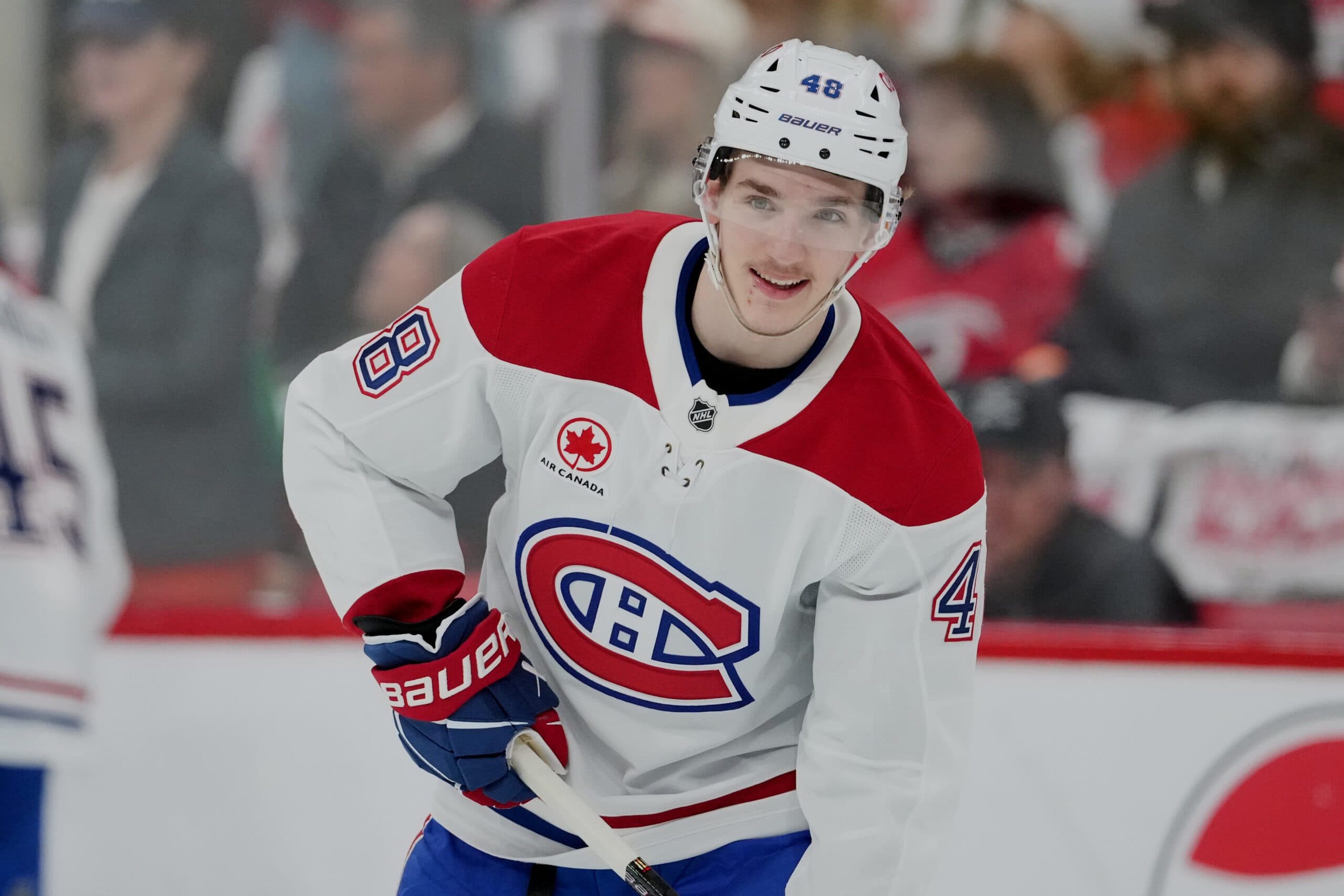
Last year’s Norris Trophy voting showed just how gridlocked the upper echelon of NHL defensemen is today.
While Zach Werenski cruised to his first Norris, it was the rare reveal where a trophy’s finalists could have gone a lot of different ways. Seven defensemen earned at least three first-place votes – a result that hadn’t occurred in 44 years. There’s a wealth of talent roaming NHL bluelines right now.
If you’re new to the High Noon series, check out last week’s opener, which ranked the league’s top 50 forwards. The system uses a three-year weighted average of data-driven results to rank NHL players by position. High Noon is hockey’s answer to the individual global player hierarchies in golf and tennis.
Can Cale Makar become just the fourth defender ever to hold the #1 crown for six straight years? How high will Evan Bouchard rise after outscoring all defensemen by 14 points? Where will Quinn Hughes land after a turbulent year filled with rumors? Where will unanimous rookie of the year Matthew Schaefer debut?
We’re ranking the NHL’s top 40 defensemen, debating the top eight, challenging the surprises, highlighting the movers and shakers, remembering the era’s best, and tracking the recent top draft picks.
It’s Part 2 of our three-part series by position: the top 40 defensemen in the NHL today.
🕛 High Noon Background
High Noon was originally a tool to guide Hall of Fame debates. The system uses a weighted three-year average: 2025-26 is 50% of a player’s score; 2024-25 gets one-third (33%); 2023-24 is one-sixth (17%). The split ensures fluke seasons or injuries don’t distort the rankings.
An important retroactive change made this year is how players in their first three seasons are handled. Previously, a player built a score over three years. Schaefer, for example, wouldn’t have a complete High Noon score until 2028. Given he’s an elite defenseman already, this needed to be fixed. Now, the score for any player in their first three full-time seasons is based 100% on the past season, ensuring all players have a fair shot in the rankings.
Here is some additional background on High Noon’s methodology:
- By using an adjusted version of point shares, High Noon is driven by box score stats, not advanced data. The rankings reflect results over process, ignoring competition and linemates.
- Players get credit for their share of team defense using ice time and team-relative plus-minus.
- The methodology does not project. The rankings cover what a player has done, not what they might do. If a 25-year-old and 35-year-old have performed similarly, they will be ranked similarly.
- Goals are more valuable than assists, having a more direct impact on scoring overall.
- Playoffs aren’t factored. Postseason opportunities are earned by teams, not individuals.
The High Noon system is a simplified version of performance based on per-game output, delivering results empirically to reduce reputational noise. The ranking offers a middle ground between raw points and analytics — the wide space where the majority of fans consume hockey.
👑 The Top 40
How to Read the Rankings: Adam Fox’s score in the High Noon system below is 10.1, ranking him the #8 defenseman in the NHL. The Change column (-4) shows his drop from #4 last offseason to #8 today. Fox’s career peak (his High Noon) is #2, the highest he’s ever been ranked (2022, 2024).
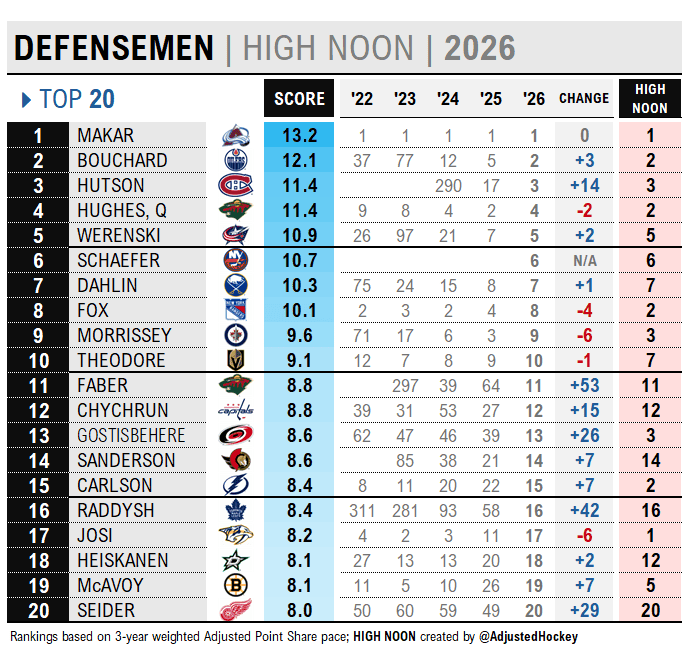
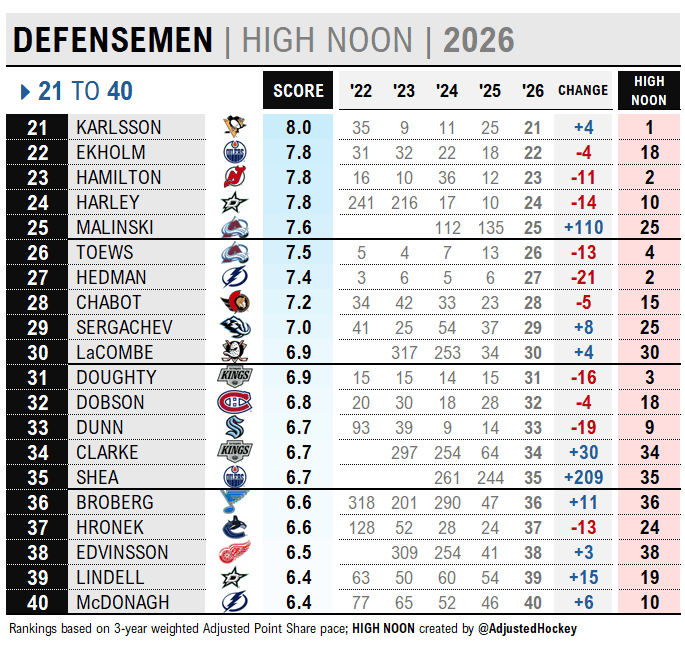
JUST MISSED: Luke Hughes (#41); Brent Burns (#42); Gustav Forsling (#43); Seth Jones (#44); Jonas Brodin (#45)
1️⃣ Who’s #1?
It’s been lonely at the top for Makar. After debuting at #5 in High Noon following the pandemic-shortened 2019-20 season, the Colorado Avalanche‘s $163-million man has been the NHL’s top dog ever since. Given Makar has been a Norris finalist the last six seasons and remains #1 reputationally per HockeyStats.com‘s public voting, we’ll say congrats and move on.
(For history buffs, only Ray Bourque (10x), Bobby Orr (8x), Eddie Shore (7x), and Red Kelly (7x) have been #1 longer among defensemen. Bourque and Orr did it eight straight years, the record at the position.)
It’s spots #2 through #7 where the debate gets spicy.
I’m certain many of you read the list above and thought: “Evan Bouchard is just not the second-best defensemen in the NHL.” Reputationally, the 26-year-old is a distant #11 in public voting. But this speaks more to how we evaluate players once a narrative emerges that they are a defensive liability. We tend to ignore everything else — including the actual results.
Offensively, Bouchard has few equals as a scorer or play driver over the last three seasons. All stats below are normalized at an 82-game pace.
| Player | Goals | Assists | Points 🔽 | 5v5 GF | 5v5 GA | 5v5 Diff | 5v5 SV% | Norris |
| Makar | 25 | 67 | 92 | 78 | 56 | +22 | .914 | 3/1/2 |
| Hughes | 15 | 75 | 90 | 89 | 71 | +18 | .901 | 1/3/7 |
| Bouchard | 18 | 64 | 82 | 84 | 64 | +20 | .896 | 5/11/4 |
| Werenski | 20 | 60 | 80 | 90 | 72 | +18 | .913 | X/2/1 |
| Fox | 15 | 62 | 77 | 69 | 49 | +20 | .921 | 4/12/14 |
| Hutson | 9 | 63 | 72 | 83 | 60 | +23 | .905 | X/9/6 |
But it’s defensively where the Bouchard myth evaporates. At 5v5, he’s been on the ice for 64 goals against per 82 games, middle of the pack above. And that’s playing on a high-risk, high-reward team, receiving by far the worst goaltending in the group (on-ice .896 save percentage), and weathering 53 postseason games in three seasons. Still, Edmonton winds up plus-20 per 82 games with Bouchard on the ice, topped only by Hutson (who doesn’t often play top competition) and the position’s gold standard in Makar.
Each of Makar and Hughes have seen meaningful drops in their defensive metrics the last two seasons. But it tends to get swept under the rug. The pair are deemed smooth, calculated, or cerebral — the implication being their mistakes are part of a tremendous, purposeful package. Both Bouchard and Hutson, meanwhile, were solid defensively at 5-on-5 last year, yet those results were muted, neither fitting the ideal physical or reputational mold of their peers. Adam Fox has long faced similar biases.
Ultimately, the order of the top eight defensemen may be in the eye of the beholder. But by the numbers, Bouchard belongs near the top of the High Noon rankings — he hit career highs in goals (21), assists (74), and points (95) in 2025-26, finished fourth in Norris voting, and contributed above-average defense while navigating suspect goaltending and extremely tough matchups.
High Noon: Top 5 Defensemen, Last 5 Years
| 2022 | 2023 | 2024 | 2025 | 2026 | |
| #1 (# of times) | Makar (2nd) | Makar (3rd) | Makar (4th) | Makar (5th) | Makar (6th) |
| #2 | Fox | Josi | Fox | Hughes | Bouchard |
| #3 | Hedman | Fox | Josi | Morrissey | Hutson |
| #4 | Josi | Toews | Hughes | Fox | Hughes |
| #5 | Toews | McAvoy | Hedman | Bouchard | Werenski |
⬆️ Too High?
Lane Hutson (#3), Montreal: Any time Hutson’s brilliant career start is brought up, there is a but. But he’s so small. But he doesn’t kill penalties. But he’s still unproven defensively. Everyone should take notice on what Hutson has done. His defensive metrics went from poor as a rookie to above average as a sophomore. At 5-on-5, his on-ice goal differential was plus-36, tied for second among defensemen. And then there’s this: only two defensemen in NHL history — Bobby Orr and Paul Coffey — have scored more points in their age 20 and 21 seasons than Hutson’s 144.
Shayne Gostisbehere (#13), Carolina: High Noon loves a skilled but sheltered defensemen. And why not? Gostisbehere is quietly an elite specialist. In second-pair minutes on a bargain contract, he’s 12th among defensemen in points-per-game (0.73) and 13th in points (151) over the last three seasons. Gostisbehere scored at a 75-point pace and the Hurricanes won his 5-on-5 minutes 47-35 last season. His basic and advanced stats are great, he led a Stanley Cup winner in regular season and playoff points, and he’s one of the most underappreciated secret weapons in hockey.
Ryan Shea (#35), Edmonton: This is much too high for Shea. There’s a few reasons. First, even though he’s 28, he’s only in his third season, so High Noon only factors 2025-26. And puck luck was on Shea’s side to the extreme on both ends of the rink last season. He should have been near break-even on goal differential, but ended up plus-30. If his score covered three seasons, he’d slot in at #117, more in line with the steady, middle-pair guy the Oilers are expecting. Shea had a breakout year, but his ranking has found a soft spot in the system.
OTHER NOTABLES: Evan Bouchard (#2); John Carlson (#15); Mattias Ekholm (#22); Dougie Hamilton (#23); Sam Malinski (#25)
⬇️ Too Low?
Moritz Seider (#20), Detroit: Seider was exceptional last season by any measure, earning his fifth place finish in Norris voting and a handful of down-ballot Hart votes. If his ranking was based on 2025-26 alone, he’d be #9 in High Noon. But that was the first season the now 25-year-old topped 50 points or garnered Norris votes. While his special teams play is still shaky, Seider’s a great bet to shoot into the top 10 in 2027. He’s the real deal.
Gustav Forsling (#43), Florida: After two brilliant, Cup-winning seasons, Forsling was among the many Panthers that spent much of the season in hangover mode. While brutal goaltending was part of the equation, Forsling was outscored by seven at 5-on-5 after two seasons as one of the NHL’s best shutdown guys. Offensively, he scored just two goals after four straight seasons in double digits. With some rest, puck luck and better goaltending in Florida, Forsling (#16 in 2025) should slide back up.
Jaccob Slavin (#76), Carolina: If Gostisbehere is a High Noon hero, Slavin is the opposite right now. He was irrefutably critical to Team USA and Carolina’s championship runs. But he was banged up most of last season, played just 39 games (eight points), snapped a nine-year run of securing at least one Norris vote, and has become increasingly more of a one-way threat. At 32, Slavin remains one of the league’s most respected and best defensive defensemen. While it’s unlikely he reaches his High Noon of #19 (twice: 2017, 2022) again, he’s #10 by reputation in public voting.
OTHER NOTABLES: Zach Werenski (#5); Miro Heiskanen (#18); Noah Hanifin (#49); Travis Sanheim (#52); K’Andre Miller (#62)
📈 Trending Up
Five Biggest Jumps Into the Top 40:
- 1. Ryan Shea, Edmonton: +209 spots (from #244 to #35)
- 2. Sam Malinski, Colorado: +110 spots (from #135 to #25)
- 3. Brock Faber, Minnesota: +53 spots (from #64 to #11)
- 4. Darren Raddysh, Toronto: +42 spots (from #58 to #16)
- 5. Brandt Clarke, Los Angeles: +30 spots (from #64 to #34)
Five Biggest Jumps Into the Top 80:
- 1. Simon Nemec, Calgary: +193 spots (from #270 to #77)
- 2. Mason Lohrei, Boston: +144 spots (from #218 to #74)
- 3. Mattias Samuelsson, Buffalo: +112 spots (from #165 to #53)
- 4. Denton Mateychuk, Columbus: +84 spots (from #132 to #48)
- 5. J.J. Moser, Tampa Bay: +48 spots (from #105 to #57)
📉 Trending Down
Ten Biggest Drops Among Last Year’s Top 80:
- 1. Michael Kesselring, San Jose: -196 spots (#79 to #275)
- 2. Alexander Romanov, NY Islanders: -126 spots (from #78 to #204)
- 3. Matt Grzelcyk, Free Agent: -68 spots (from #75 to #143)
- 4. Dmitry Orlov, San Jose: -50 spots (from #61 to #111)
- 5. Darnell Nurse, San Jose: -48 spots (from #51 to 99)
- 6. Marcus Pettersson, NY Rangers: -47 spots (from #67 to #114)
- T7. MacKenzie Weegar, Utah: -41 spots (from #19 to #60)
- T7. Jake Walman, Edmonton: -41 spots (from #45 to #86)
- 9. Brady Skjei, Nashville: -40 spots (from #43 to #83)
- 10. Kaiden Guehle, Montreal: -38 spots (from #70 to #108)
⌛ Legend Watch
Timeline of active defensemen over 35 years old that once reached top-three status in High Noon
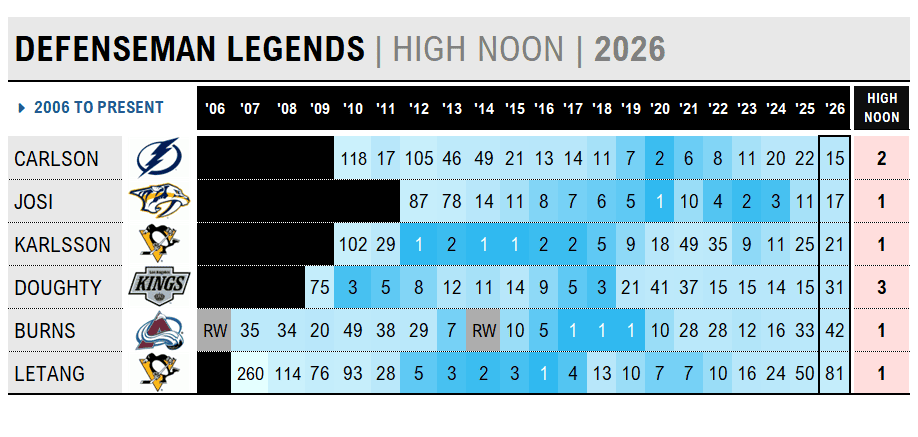
Veterans near the ends of their careers can feel overrated given High Noon’s three-season window. Why? An older player’s score may capture a level they won’t ever reach again. Yes, even the greats eventually decline — often quickly as they age deeper into their 30s. With that in mind, we’re celebrating the peaks of six iconic defensemen over the last two decades.
- John Carlson (#15), Tampa Bay, Age: 36: Top-20 defenseman 11x (tied for 43rd)
- Roman Josi (#17), Nashville, Age: 36: Top-10 defenseman 9x straight (tied for 20th)
- Erik Karlsson (#21), Pittsburgh, Age: 36: Top-2 defenseman 6x straight
- Only Ray Bourque (9x), Orr (9x) and Coffey (7x) have longer streaks post-expansion
- Drew Doughty (#31), Los Angeles, Age: 36: Top-15 defenseman 13x (tied for 18th)
- Brent Burns (#42), Colorado, Age: 41: One of 16 defensemen to reach #1 spot 3x
- Kris Letang (#81), Pittsburgh, Age: 39: Top-5 defenseman 6x straight
- Only Makar and Karlsson (7x each) have longer streaks in the cap era
- Only Makar and Karlsson (7x each) have longer streaks in the cap era
⏳ Future Watch
High Noon progression of the defensemen taken earliest in the 2021 to 2025 NHL Entry Drafts
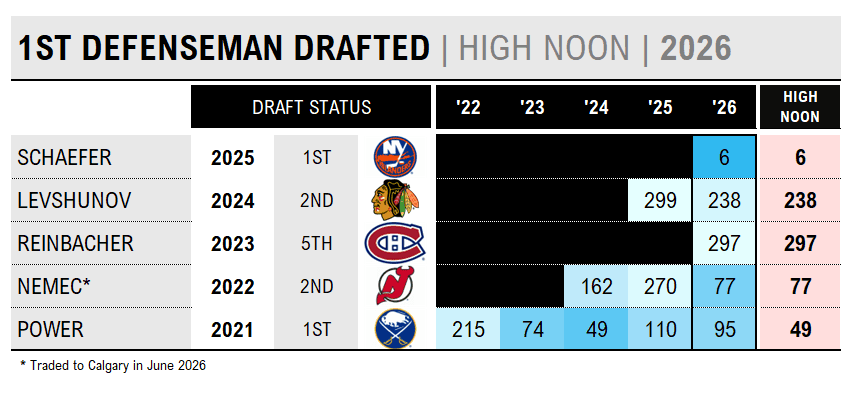
Schaefer is one of only four defensemen from the 2021 to 2025 drafts in High Noon’s Top 40: Lane Hutson (#3, selected 62nd in 2022); Brandt Clarke (#34, selected 8th in 2021); Simon Edvinsson (#38, selected 6th in 2021). It reinforces that the development curve for defensemen is often a long and winding road. As a reminder, the first defensemen taken in 2026 was Daxon Rudolph (by Buffalo via the Bowen Byram trade).
Stay tuned the the final instalment of the High Noon series next week: Part Three (Goaltenders).
Data from Hockey-Reference; HockeyStats.com
Recently by Paul Pidutti
- High Noon 2026: Ranking the NHL’s top 50 forwards
- NHL 2030: Projecting the standings from 32nd to Stanley Cup champion
- NHL 2030: Projecting the top 30 players of the future
- The Torch: Naming the best player for every year in NHL history
_____
CHECK OUT OFF THE ROSTER – NEW EPISODES EVERY WEEKDAY

Off The Roster is Toronto sports. Hosted by Cabbie Richards, Lindsay Dunn, and Dan Riccio, this is the go-to morning conversation for everything happening in the 6ix – Hockey, Baseball, Basketball and everything in between. From breakout performances and questionable trades to throwback jerseys, viral moments, and the stories fans are actually talking about – it’s smart, sharp, and never scripted. Live weekday mornings on the Nation Network YouTube channel and available wherever you stream podcasts, the show delivers real opinions, real chemistry, and real Toronto energy. Missed an episode? Catch up anytime. Off The Roster—The new sound of the 6ix.