2026-27 NHL team preview: New York Rangers

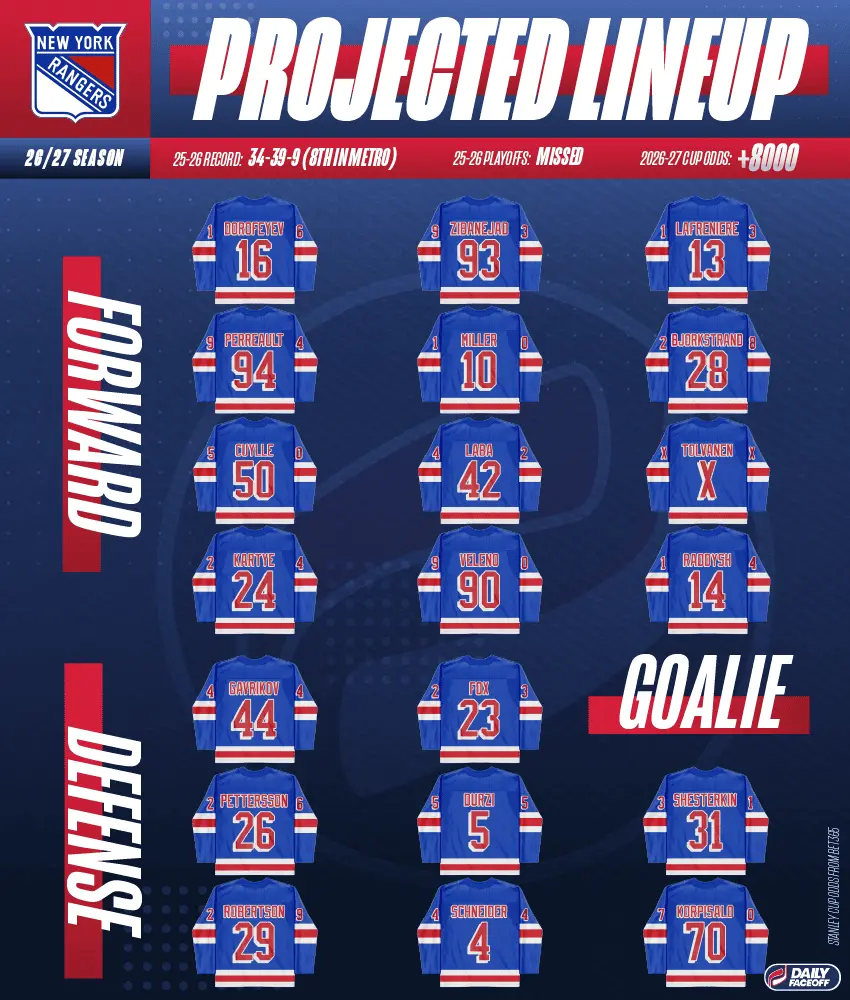
X = Player has not yet chosen new number, per team spokesperson
LAST SEASON
The 2025-26 season was supposed to be a bounceback campaign in which the New York Rangers proved that their crash-and-burn effort from 2024-25 that saw them go from winning the Presidents’ Trophy the year prior to out of the playoffs altogether was a fluke. They moved on from coach Peter Laviolette and hired two-time Stanley Cup champion Mike Sullivan to tighten up the schematics, and with J.T. Miller freshly named as captain and ready to spend a full season back on Broadway, things were looking up.
Instead, Ranger fans were served up another disaster. The season began with an embarrassing run of being shut out at home (New York didn’t score on Madison Square Garden ice until the fourth home game), which set up a 3-5-2 start to the year that immediately put them well behind the eight-ball.
The next two months were a big improvement, highlighted by a 5-1 win over the Florida Panthers at the Winter Classic in South Florida, improving New York’s record to 20-18-5, but it was immediately followed by a streak of five consecutive losses in which they were outscored 30-12 as star goalie Igor Shesterkin and defenseman Adam Fox were both sidelined with injuries. Without those two franchise pillars, the roster lacked the strength in other areas to keep the season afloat, and the losses piled up until the season came to an end with a 34-39-9 record that saw them finish last in the Metropolitan Division by a 10-point margin.
Between last Trade Deadline season and this summer, general manager Chris Drury has focused on selling where possible to a degree. He moved Artemi Panarin to the Los Angeles Kings last deadline and followed that up this summer by dealing Vincent Trocheck to the Utah Mammoth. In doing so, Drury has also acquired some talent that can help the team now, getting defenseman Sean Durzi back as part of the return for Trocheck and dealing some draft capital to add talented scorer Pavel Dorofeyev from the Vegas Golden Knights.
There will unquestionably be a different feel to the Rangers this season, while plenty of familiar faces from the teams that contended earlier in the first half of the decade are set to return. Will a more structured year two with Sullivan combined with good health from Fox and Shesterkin be enough to fuel a return to the playoffs, or is New York destined for a third straight season of missing out on the dance?
KEY ADDITIONS & DEPARTURES
Additions
Pavel Dorofeyev, RW
Oliver Bjorkstrand, RW
Marcus Pettersson, LD
Sean Durzi, RD
Eeli Tolvanen, RW
Joe Veleno, C
Joonas Korpisalo, G
Cole Beaudoin, C
Dennis Cholowski, D
Alberts Smits, D
Departures
Vincent Trocheck, C (Uta)
Jonathan Quick, G (retired)
Will Borgen, D (Bos)
Jonny Brodzinski, C (Wsh)
Brendan Brisson, C (Tor)
Casey Fitzgerald, D (Fla)
Conor Sheary, LW (Buf)
Adam Edstrsom, F (Nsh)
Brett Berard, LW (Mtl)
OFFENSE
Few players on the Rangers had the sort of year they were looking for when the season began last October. The clear exception to that is Mika Zibanejad, who was widely speculated to be on the outs if he would waive his trade protection but stuck around and wound up as New York’s leading producer by a lot, with 78 points in 81 games played.
Now, he returns to be one of the centerpieces of the Rangers’ offensive attack, alongside Miller (53 points), Alexis Lafreniere (57 points) and the newly acquired Dorofeyev, who racked up 37 goals in 82 regular season games and 12 goals in 22 Stanley Cup playoff games last year with the Golden Knights.
While Trocheck and Panarin being gone is a big detraction from the group that began last season, Drury made several moves to try to add players who can provide support scoring behind his big guns. Eeli Tolvanen and Oliver Bjorkstrand aren’t going to set the world on fire, but they’re reliable 30-40 point producers who can step up when called upon.
One of the more exciting aspects of this upcoming season will be the growth of the Rangers’ stable of young forwards. It’s year two as full-time NHLers for Gabe Perreault and Noah Laba, who notched 27 and 24 points last season, respectively. They both look like solid bets to at least perform as quality middle-sixers this season, but the upside for more, particularly with Perreault, is one of the biggest reasons to be bullish on the Rangers this year.
This forward group doesn’t look as strong at the top as it did two years ago or even at the outset last season, but the new acquisitions and the emergence of Laba as a capable center mean the second, third and fourth lines are all stocked with capable NHL players for their respective roles, which is something that frequently could not be said last year.
At the bottom of the lineup, watch out for Tye Kartye. Unheralded as a late-season waiver claim from the Seattle Kraken last year, he stood out as a huge bright spot down the stretch for the Rangers, notching 14 points in 24 games after putting up just eight in 40 contests with the Kraken.
DEFENSE
If Drury has been willing to look toward the future in his decision-making around the forward a bit by moving Trocheck and Panarin, he’s taken the opposite approach on defense, and for good reason.
Sullivan’s arrival stopped much of the defensive bleeding according to the underlying numbers. Under Laviolette in 2024-25, New York ranked 28th in the NHL with 2.76 expected goals against per 60 minutes at 5-on-5. That improved last season to 2.55, good for 11th in the league. Despite the considerable underlying improvement, you wouldn’t find many Ranger fans who were satisfied with the defensive effort last year, and based upon the additions of Durzi and Pettersson, Drury likely wasn’t either.
After trading K’Andre Miller last summer, it seemed like, whether he knew it or not, Druruy was signing up to have two bottom pairings behind a new-look top unit of Fox and Vladislav Gavrikov. With Pettersson and Durzi in the mix, there’s a clear duo that looks capable of handling 20 minutes a night against opponents’ second lines, something that wasn’t really the case a year ago.
Still, so much of how this defense performs will come down to the health of Fox. The 28-year-old took a lot of heat last year when he was left off the American Olympic team by a brass that included his own NHL general manager and head coach, and then that team went on to capture the gold medal without him. There has been a lot of subsequent discourse about the things Fox can’t do that has quickly come to overshadow the many things he can do.
Fox was still elite when available last year, racking up 53 points in his 55 regular season games and controlling an astonishing 58.63% of the expected goals at 5-on-5. The next closest Ranger, Lafreniere, was only at 53.45%. When Fox is healthy, the Ranger blueline is led by an top-tier producer who is capable of overcoming a mediocre environment to produce dominant underlying numbers. A better second pairing means he should have fewer flaws to cover up, but this unit is still in big trouble if Fox misses any meaningful amount of time again,
GOALTENDING
Much like the defense, the crease for New York is all about the health of its star. Shesterkin is arguably the best goalie in the NHL when healthy, and over the years, he like Fox has done a lot to cover for some bad individual play and subpar roster construction.
It was more of the same in 2025-26, as Shesterkin posted a .912 save percentage and 2.50 goals against average to go with his 25-19-6 record in his 51 starts and appearances. Among the 71 NHL goalies who played at least 10 full games last year, Shesterkin ranked fifth with 0.45 goals saved above average per 60 and second among the cohort of workhorse goalies with at least 50 appearances.
A healthy Shesterkin is a money-in-the-bank Vezina Trophy candidate who is extremely likely to lift New York’s floor high enough to avoid another last-place finish in the division. If he’s not healthy, the contingency plan shifts from the now-retired Jonathan Quick to veteran Joonas Korpisalo. Quick was comfortably, but not egregiously, below league average last year (-0.12 GSAA/60). In his 31 games last season backing up Jeremy Swayman for the Boston Bruins, Korpisalo was a bit better with -0.04 GSAA/60 to go with his .894 SV% and 3.15 GAA.
The Metro is a tough goaltending division with Logan Thompson in with the Washington Capitals and Ilya Sorokin leading the charge for the Rangers’ local rivals, the New York Islanders, but Shesterkin is the class of the league when he’s healthy and on his game. The improved defense should help make his job easier, too, and a second Vezina trophy as the NHL’s top goalie is certainly in the cards if this season doesn’t fall apart the way the last two have for the Rangers.
COACHING
This will be year two for Sullivan behind the Blueshirt bench as the head boss. He had a previous stint as an assistant for the Rangers under John Tortorella in the 2010s, and he will make history on Opening Night, which will be the 1,000th game of his career as an NHL head coach. He notched his 500th win last season, and his 513 for his career place him 28th in the NHL in the history of the profession. He’s proven to be a cheat code for improving possession and shot quality metrics throughout his career, and the improvement he brought New York last season was noticeable on the spreadsheet if not in the standings. Is there enough talent on this roster for Sullivan to spark that jump, too?
He has plenty of head coaching experience on his bench, including that of former Rangers head coach David Quinn, who returned to New York last season after a second opportunity as a head coach with the San Jose Sharks. There’s also veteran Joe Sacco, who has 356 games under his belt as a head coach split between the Colorado Avalanche and Boston Bruins. There’s also Ty Hennes, who was on Sullivan’s staff in Pittsburgh as a skills coach and returns for a second year in New York.
As mentioned previously, the braintrust was able to bring considerable growth to the Rangers’ ability to drive shot share and quality, but the results were not there in the end. The staff was also effective on special teams, as New York finished 15th in the league on the penalty kill with a 79.9 percent success rate and fifth on the power play, converting on 24.7 percent of their opportunities.
ROOKIES
While he’s drawn warranted criticism in recent years for the organizational approach to drafting and development, Drury has donee well to restock the pipeline with potential impact contributors on rookie deals. Alberts Smits, chosen with the No. 5 overall pick in this past June’s draft, is physically ready to step in on an NHL blueline right away. New York has enough capable bodies to make that a luxury option more than a mandatory plan, but if Smits impresses in camp, he could bring an interesting element to New York’s bottom pairing.
There’s also Liam Greentree and Cole Beaudoin, a pair of interesting 20-year-olds Drury acquired in the Panarin and Trocheck trades, respectively. Like Smits, neither of them is being penciled in as immediate must-have contributor this season, but the opportunity is right there for the taking. If Greentree and Beaudoin aren’t NHL options immediately, look for them to put up some gaudy numbers in the AHL with the Hartford Wolf Pack.
BURNING QUESTIONS
1. Can Pavel Dorofeyev work as a primary offensive engine? Drury paid a premium at the NHL Draft to add a coveted scoring winger to his team in Dorofeyev. Vegas was facing a salary-cap crunch, and the opportunity to add the No. 26 and 92 overall picks in that night’s draft plus a top-10 protected pick from a team spinning its wheels was enough to seal the deal. The question becomes whether Dorofeyev can replicate his impressive output from last season in an offensive environment where there is no Jack Eichel, Mitch Marner, or Mark Stone to draw defensive attention away from him. He’s not completely bereft of help on the Rangers, but it will be an entirely different challenge for the $77-million man.
2. Is this finally the year for the Alexis Lafreniere breakout? The 2020 No. 1 overall pick seemed to be on the verge of stardom two years ago after his 57 points in 82 games in his fourth season helped fuel the Presidents’ Trophy win and run to the Eastern Conference Final. In October of 2024, he signed a seven-year extension with a salary cap hit of $7.45 million. That looked expensive as he struggled to just 45 points in 82 games that year, but with the cap having jumped considerably twice since, with plenty of room for more, it looks perfectly reasonable even if he stays at his current rate of productions. His 57 points last year matched a career high, but Lafreniere has a chance to deliver real surplus value on his contract if he can just take the next step toward being the 65-70-point player he has long been projected as.
3. How long is Drury’s leash if things go sideways? Drury was named GM of the Rangers in May of 2021, and he helped build on a solid young foundation left behind by predecessor Jeff Gorton to make the Eastern Conference Final in 2022 and 2024. As the impact of Gorton’s work has faded and the roster has been increasingly shaped by Drury’s decisions, things have gotten worse. Some ill-advised moves on defense and an eagerness to strip away from the 2024 core have led to two straight missed postseasons while players cast aside have thrived elsewhere. New York could have used the depth scoring veteran Chris Kreider provided for the Anaheim Ducks last season as they made the playoffs. They could have used the version of K’Andre Miller that carried a second pairing of a Stanley Cup champion in Carolina. Good players have gone out the door, and their replacements have fared worse while the team has struggled. This offseason looks like a solid step in the right direction for Drury, but what if Dorofeyev, Pettersson and Durzi aren’t enough to turn the tide? With the Knicks winning the NBA title, does the Dolan family tolerate another lost season from MSG’s other headline sporting attraction?
PREDICTION
The Metro’s reputation took a big hit last season when the eventual Stanley Cup champion Carolina Hurricanes were the only of the division’s eight teams who looked even remotely like a contender, but that obscures the fact that the Rangers were the only team in the division to finish with fewer than 87 points. Everybody else was at least pretty competitive.
That means if New York is going to turn things around and return to being a playoff team, they have a sizable gap in the standings to make up on not only at least four of their divisional foes, but likely even some of the quality teams in the bottom half of the Atlantic Division.
Full, healthy seasons from Fox and Shesterkin would go a long way toward closing that gap, but is there enough quality on this roster to sustain some inevitable setbacks and injuries and come out ahead of some quality teams in the standings anyway? It’s pretty easy to have some skepticism there.
The absolute ceiling for this Rangers team is likely a third-place finish in the Metro, but a lot would have to go right to make that happen. Drury is asking a lot of a pair of aging veterans in Zibanejad and Miller to carry the forward group as its top two centers, and since a prolonged injury to either Fox or Shesterkin most likely seals it anyway, it’s considerably more likely that the Blueshirts miss postseason for the third year in a row than make it in.
_____
DAILY FACEOFF NEWSLETTER