Do only six teams have a real shot at the 2027 Stanley Cup?


In October, hope among NHL fanbases is as vivid as the autumn leaves.
All but a handful of the league’s 32 franchises have playoff aspirations. At least a dozen teams see a Stanley Cup in 2027 as a realistic possibility if things break right.
But the modern list of Stanley Cup champions tells a much different story. This June, it will be 15 years since a team lifted hockey’s most iconic trophy without first establishing itself as a recurring regular-season threat and adding multiple, credible postseason runs.
The NHL is a salary-cap league that prides itself on parity and the best postseason in sports. Yet, a routine review of the last 14 title winners suggests that only six teams have a real chance at the Cup. Yes, six. We’re always debating the recipe or magic formula that delivers Stanley Cups. Perhaps it’s not that complicated after all.
🏆 Modern Stanley Cup History
At the risk of this article winding up on the Freezing Cold Takes X feed, it needs to be said: any team can win the Stanley Cup.
They play the games for a reason. Between regular season ‘loser’ points skewing the standings, an unfair playoff bracket, the randomness of goaltending, small postseason samples and good, old fashioned luck, anything can happen in the NHL. We see dazzling comebacks, shocking upsets and surprising performances all the time.
But when we look at the last 14 Stanley Cup champions, a couple of trends have emerged.
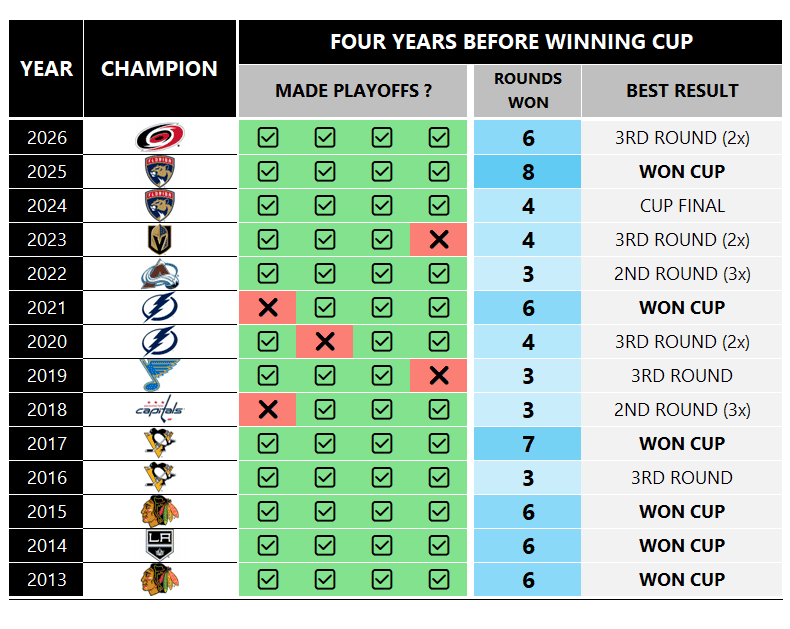
What do you notice?
In the four years before their title runs, every Cup winner:
- Made the playoffs at least three times. That means four (or five) postseason trips in five years.
- Won at least three playoff series. At a minimum, each made the final eight teams multiple times.
Simply put: up-and-coming franchises aren’t winning Stanley Cups anymore. Core groups with some scar tissue are the ones going all the way. A few upstart teams inevitably level up annually. But such a team hasn’t won a title since Drew Doughty was 22 and still had all of his teeth.
The last franchise to raise the Cup without both established regular season and playoff pedigree? The Los Angeles Kings in 2012. Those Kings rode Conn Smythe-level goaltending from Jonathan Quick and a friendly playoff path after a Round 1 upset to reach the NHL mountain top earlier than expected. That team remains the last of its kind.
Since then, it’s clubs that are strong in the regular season for a half-decade or more that are winning Cups. And just being good enough to hang in the top half of the league by making the postseason consistently isn’t enough. The teams capturing rings are also battle-tested, apprenticing as legitimate contenders by winning playoff rounds before graduating to champion status.
That brings us to the 2026-27 season. We’ll use what we know about recent Cup winners to limit the field to teams that meet our criteria. So, who are the six contenders with the track record to compete for the 2027 Stanley Cup?
🪜 Step #1: Become a recurring regular season threat
Criteria: Make the playoffs at least four times in five years.
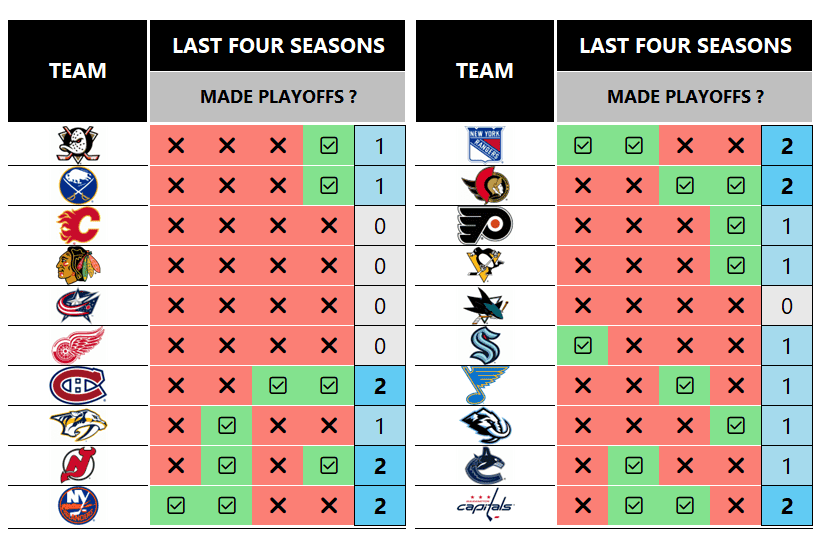
Eliminated (20): Anaheim; Buffalo; Calgary; Chicago; Columbus; Detroit; Montreal; Nashville; New Jersey; NY Islanders; NY Rangers; Ottawa; Philadelphia; Pittsburgh; San Jose; Seattle; St. Louis; Utah; Vancouver; Washington
Nearly two-thirds of the league gets left in the dust from this requirement alone. Even with a 2027 playoff spot, none of these 20 franchises can make the prerequisite four appearances in five seasons.
Montreal stands out the most, having made the playoffs back-to-back and reaching the Eastern Conference Final this past spring. But the modern champion criteria says that’s not enough. The Habs must win at least one more series in 2027 to dream big for the 2028 playoffs. This makes sense. Jakub Dobes masked Montreal’s ugly 42 percent expected goal share at 5-on-5 in the postseason. Getting outplayed, winning a lot of close games, and riding a hot goalie isn’t a Cup-winning formula in a deep, 32-team league. The luck eventually runs out trying to win 16 games without controlling play.
The Lesson: Teams need to be consistently capable in the regular season first. Why? No one is winning the Cup on their first few tries. Becoming a postseason fixture yields more chances at a favorable path, home-ice advantage, ideal matchups, and good fortune. While not every Cup champion has cruised through the regular season (hello, 2019 Blues), each core group created enough opportunities by making the postseason dance many times.
🚀 Step #2: Become a recurring playoff threat
Criteria: Win at least three playoff rounds in the four postseasons before winning the Cup.
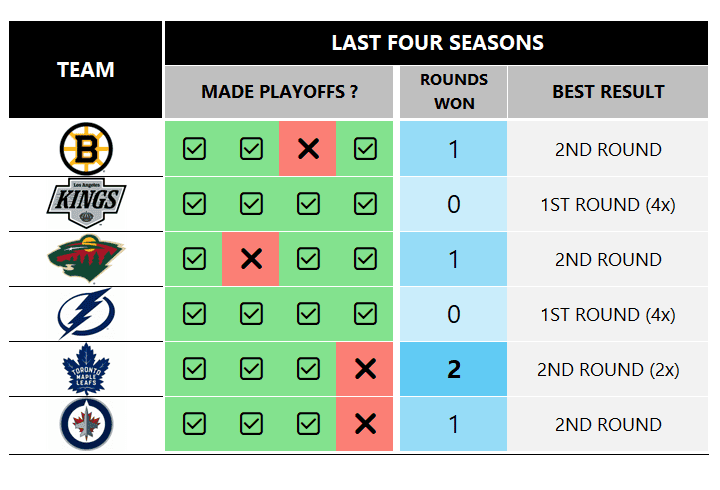
Eliminated (6): Boston; Los Angeles; Minnesota; Tampa Bay; Toronto; Winnipeg
Our second criterion cuts the remaining Cup contender field in half, from a dozen to just six franchises. Each of the teams above have largely been playoff fixtures the last four years (2023 to 2026). Yes, Boston and Minnesota had one-year hiccups, and Toronto and Winnipeg weren’t even close in 2026. But should any of these teams make the postseason in 2027, they would meet the prerequisite four appearances in a five-season stretch. That’s not easy to do when only 50% of the league gets in annually.
Franchises can miss the playoffs once and recover (i.e., 2022 Golden Knights, 2018 Blues, 2017 Lightning, 2014 Capitals). Sometimes nothing goes your way in the regular season — major injuries, insurmountably bad goaltending, internal chaos, or roster fatigue, for example. Think the Florida Panthers last year. But two playoff misses in five seasons have ended modern Cup dreams.
Making the postseason hasn’t been the problem for these six teams, though. Making actual playoff noise has been the issue. Tampa pops among the teams getting axed here. They have strong market odds, a great roster and excellent coaching. But the Lightning haven’t won a playoff series since 2022. Hard to believe. Incredibly, the Toronto Maple Leafs have won two more rounds than Tampa in the last four years. So, the modern Cup criteria says the Bolts aren’t a real threat anymore.
The Lesson: Being playoff battle-tested has been a prerequisite to lift the Cup for a long time now. Every single Cup winner since 2013 has either reached the Second Round three times or made the Conference Finals in the four years before their Cup runs. The average Cup winner won 4.9 playoff series in four years before making it through the four-round gauntlet successfully. Seven of the last 14 champions had recently reached the Cup Final and six of them had won the Cup in the previous four years. Going back to 2010, each of Florida (2024, 2025), Tampa (2020, 2021), Pittsburgh (2016, 2017), Chicago (2010, 2013, 2015) and Los Angeles (2012, 2014) won multiple Cups in a narrow window.
As a data-driven writer, declaring that ‘experience’ matters feels like using a dirty word. But it’s not adding one grizzled veteran at the Trade Deadline that is a cure-all for the type of experience that has delivered Cups.
After all, nearly every contender makes a move or two like that every year. Nazem Kadri, Scott Laughton, Corey Perry, Nick Foligno, John Carlson, Luke Schenn, Michael Bunting, Jeff Petry, Nicolas Roy, Jason Dickinson, MacKenzie Weegar, Tyler Myers, Connor Murphy, and Brett Kulak weren’t the missing links in March 2026. One team wins and the rest do not.
It’s the collective group experience that matters. Why?
- Players and coaches need to make adjustments to maximize results. Identifying what went wrong — team systems, nerves, fatigue, style of play, resilience — and making corrections is a necessary step to thrive. The 2016 Penguins under new coach Mike Sullivan come to mind.
- Front offices need to make adjustments too. Required roster revisions around a core group — adding certain types of players, more efficiently using cap space, building depth, finding better fits on lines and pairings — are easier to identify and integrate by Year Five than in the first or second shot. The 2026 Hurricanes are a great example.
- With 32 teams, 16 in the postseason, and one winner, the odds are always bad. Hoping to make the postseason once or twice and getting everything right is statistically very unlikely. Four, five or eight playoff runs means buying more lottery tickets. It took 10 playoff appearances for the 2018 Capitals to finally slay the dragon. It was Carolina’s eighth consecutive try last season.
🎯 The 2027 Stanley Cup Contenders
So, whom does that leave for our six true 2026-27 Cup contenders?
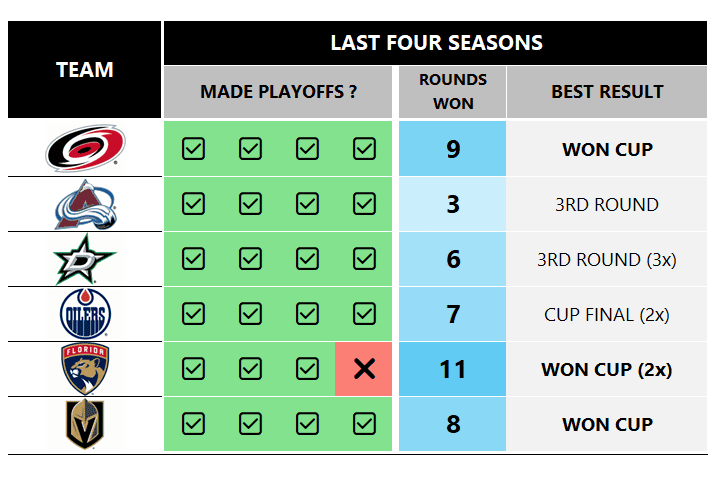
Each of the six franchises above has both made the playoffs at least three times in the last four seasons and won at least three playoff rounds. Those two factors have been true of every Cup champion since 2013. Of course, to be a contender, these six teams have to make the 2027 playoffs. All six expect to be there. But they do have to qualify first.
It’s a solid list of teams. Carolina, Colorado, Dallas, Edmonton, Florida, and Vegas are generally among the consensus top eight as pre-season Stanley Cup favorites across oddsmakers, statistical modelers, and media outlets. One of Tampa, Washington, or Minnesota might have slipped ahead in some forecasts, but none of the six teams we’ve identified as 2027 Cup contenders is outside the top 10. So, our two simple legacy criteria have successful identified teams that remain elite.
Can a team outside of these six win? Absolutely. Montreal’s core could snag the Cup on their third try ahead of schedule. Utah or Buffalo could add Connor Hellebuyck tomorrow and rock the hierarchy. Quinn Hughes could carry a strong Wild team to a title. Logan Thompson could deliver a Conn Smythe-winning performance in Washington. Maybe 2027 is the year a team light on pedigree breaks through.
But doing so would break a 15-year trend of champion criteria.
Only six franchises are proven regular season and playoff threats — mandatory credentials to spend the summer with Stanley since 2013. Will the trend continue in 2026-27? There are 26 fan bases hoping not.
Data from Hockey-Reference; HockeyStats.com
Recently by Paul Pidutti
- High Noon 2026: Ranking the NHL’s top 30 goaltenders
- High Noon 2026: Ranking the NHL’s top 40 defensemen
- High Noon 2026: Ranking the NHL’s top 50 forwards
- NHL 2030: Projecting the standings from 32nd to Stanley Cup champion
- NHL 2030: Projecting the top 30 players of the future
_____
POST SPONSORED BY bet365