2026 Hall of Fame tiers: Ranking the legends, locks and borderline cases


Hockey Hall of Fame season is here.
The Hall’s annual Induction Weekend kicks off this Saturday, a celebration of the Class of 2026‘s official enshrinement into hockey immortality. But today we’re not interested in who’s already been honored. We want to know which current superstars are future Hall of Famers.
Four years ago, my Hall of Fame player ranking tool, the Pidutti Point Share (PPS) system, got its big break on Daily Faceoff. In the years since, early November has become the ideal time to revisit the Hall trajectories of the NHL’s active stars. Which icons have already secured plaques? Which borderline talents should join the legends? Which household names may fall short? How is the standard evolving?
We’re going to move fast and check in on 48 active Hall candidates.
🚦 PPS SYSTEM
The league’s top players will be tiered by PPS. The data-driven methodology serves as a starting point for debates. It uses era-neutral inputs to equitably measure a player’s career in a single digit, eliminating reputational biases.
How does it work? PPS scores all 8,777 players in NHL history using six factors: Career (production); Pace (efficiency); Peak (seven best seasons); plus bonuses for Playoffs (postseason games, Stanley Cups); International play (best-on-best events); and Awards (vote share for major trophies).
To show the system in action, here’s 2026 Hall of Fame inductee Patrice Bergeron’s PPS card.
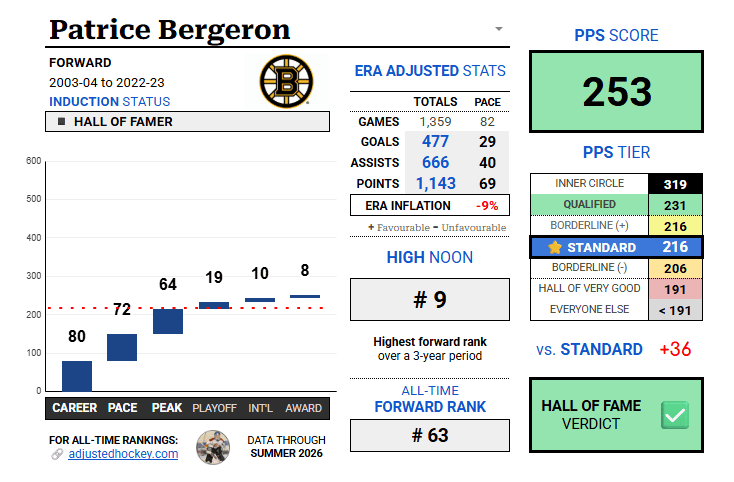
Bergeron’s PPS score of 253 comfortably places him in the Qualified tier, +36 above the forward standard. An easy Hall of Fame call. By having a score for each player, we can benchmark anyone against a Hall standard that evolves based on the number and quality of players inducted. Here are the tiers of PPS:
- Inner Circle: exclusive tier featuring the 43 greatest players of all-time
- Qualified: well above standard (+15 or more); a worthy Hall of Famer
- Borderline/Above: slightly above standard (0 to +15); edges the cutoff but expect a debate
- Borderline/Below: slightly below standard (0 to -10); fringe candidate deserving some debate
- Hall of Very Good: below standard (-10 to -25); distinguished career but not a Hall of Famer
But there is more to a career than numbers. PPS doesn’t account for: sportsmanship and character (attributes per the HHOF’s by-laws); non-NHL play (junior, college, other pro leagues); international play outside best-on-best; social impact; pioneering influence; signature moments; records held; or fame itself. These important elements are left to the user to add or subtract from a player’s score.
From G.O.A.Ts to longshots, we’re going to blast through them all with a quick note on their candidacies. The focus will be on the evolution of their Hall case since we did this last November. Let’s dive in.
FORWARDS
Forwards have the easiest time getting into the Hall of Fame. Most potential candidates that compile significant career totals or dominate for a while in shorter careers are inducted eventually.
Post-expansion forwards inducted: 66
Class of 2026: Keith Tkachuk (+39 vs. standard); Bergeron (+36)
Selection Committee accuracy per PPS: 55/66 (83%)
Active forwards above standard: 20
NOTE: PPS scores & standards through 2026 offseason; Change column: player’s PPS score versus 2025
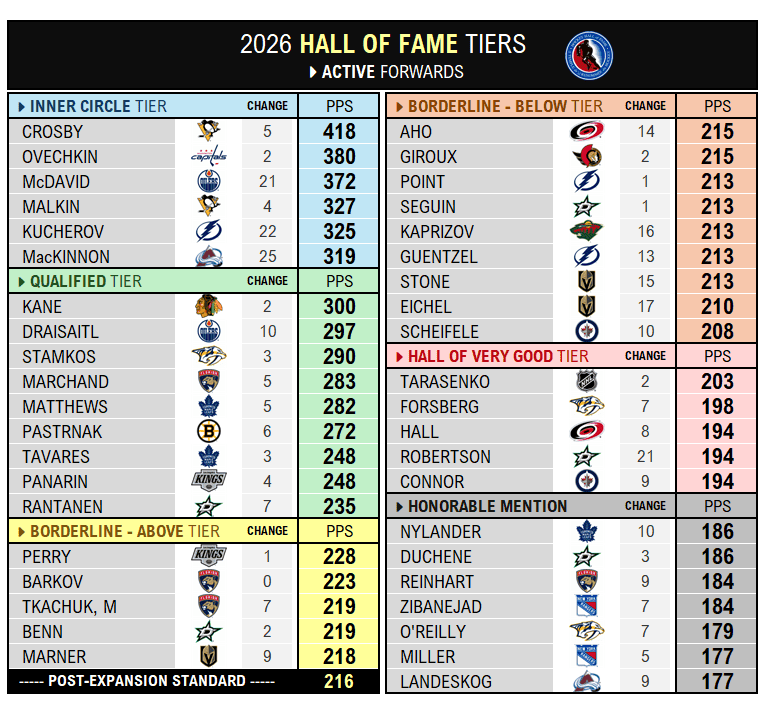
🎯 INNER CIRCLE TIER (6)
Sidney Crosby, Pittsburgh Penguins, Age on Opening Night: 39: A record-extending 21st point-per-game season, 16th playoff appearance, and Olympic Silver was tidy work for a 38-year-old. Crosby’s PPS rose +4.6 and added some daylight on Gordie Howe as the #3 forward of all-time.
Alex Ovechkin, Washington Capitals, 41: A record-extending 20th season with 30-plus goals was tidy work for a 40-year-old. Ovechkin is the #6 forward of all-time in PPS, but Connor McDavid is a near-lock to pass him this season.
Here are the G.O.A.T standings for forwards in PPS:
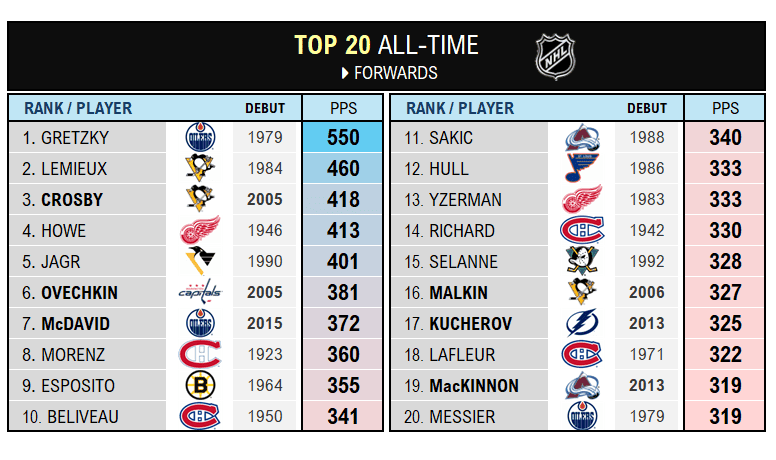
Connor McDavid, Edmonton Oilers, 29: Last season felt like a disappointment for McDavid as he settled for Olympic Silver and the Oilers lost in the First Round. But he won a sixth scoring title, fifth Ted Lindsay Award and Olympic MVP, and he was Hart Trophy runner-up. When that’s a disappointment, you’ve reached a new stratosphere. McDavid’s PPS is tracking well ahead of Crosby’s through 11 seasons (372 to 344) despite trailing by two Stanley Cups and two Olympic Golds at the same age.
Evgeni Malkin, Pittsburgh, 40: In his age-39 season, Malkin improbably delivered his 16th point-per-game season, which trails only Crosby, Gretzky, and Howe. If 2026-27 is his last dance, he’ll retire 14th or 15th in PPS among forwards. His omission from the NHL’s 100 Greatest Players in 2017 remains a historic blunder.
Nikita Kucherov, Tampa Bay Lightning, 33
Nathan MacKinnon, Colorado Avalanche, 31
Seeing Kucherov and MacKinnon graduate to the Inner Circle tier might shock some as too soon. But their consistent brilliance as perennial MVP candidates for most of a decade has little precedent. Both are universal top-five, if not top-three players, into their 30s.
✅ QUALIFIED TIER (9)
Patrick Kane, Chicago Blackhawks, 37: Kane’s solid 57 points in 67 games last season raised his PPS by +2.1. It’s unlikely to move all that much further upward. He’s 24th all-time among forwards.
Leon Draisaitl, Edmonton, 30: Draisaitl’s PPS increased +10 despite missing 15 games last season. Stanley Cup or not, he’s one of the best postseason performers ever (1.48 points per game) and is a near certainty to reach the Inner Circle tier.
Steven Stamkos, Nashville Predators, 36: No, he’s not competing for awards anymore. But Stammer has found ways to continue to snipe. A surprise 42-goal season nudged him +3.1 in PPS. On opening night, Stammer was ninth in era adjusted goals (697) and could retire top five.
Brad Marchand, Florida Panthers, 38: The super-pest was excellent last season in 52 games, adding +4.6 in PPS. He’s signed through 2031, but the jury is out on how much gas is left. Either way, he should be a Hall of Fame lock whose career offensive and defensive profiles are a surprise match to his polar opposite stylistically: Sergei Fedorov.
Auston Matthews, Toronto Maple Leafs, 29: Matthews had his worst season in 2025-26, raising his PPS just +4.8 despite captaining Team USA to Olympic glory. He’s already a Hall of Fame shoe-in, effectively matching Pavel Bure’s career plus a Hart Trophy, Olympic Gold and Selke finalist nod. No. 34 has scored at an identical rate to Ovechkin at the same age.
David Pastrnak, Boston Bruins, 30: The Bruins’ new captain is one of hockey’s most reliably dominant forces. Last season: a remarkable fourth consecutive 100-point year. With five 40-goal seasons, a Rocket Richard Trophy, and 420 goals through his age-29 season, Pasta is a Hall of Famer.
John Tavares, Toronto, 36: In his age-35 season, JT added 31 goals and 71 points, taking his era adjusted totals to 588 goals and 1,305 points. He climbed +3.0 in PPS and is an easy Hall call.
Artemi Panarin, Los Angeles Kings, 34: Traded mid-year, Panarin quietly recorded his ninth consecutive point-per-game season. In the cap era, only two others have longer streaks: Crosby (21) and McDavid (11). I’m not sure the public views Panarin as a surefire Hall of Famer. But they should start.
Mikko Rantanen, Dallas Stars, 29: PPS loves Rantanen, the poster boy for consistent, excellent production. Over the last nine seasons, he’s scored at an 82-game pace of 38 goals and 97 points. Despite missing 18 games in 2025-26, Rantanen banked 77 points, was critical to Finland’s Olympic Bronze and raised his PPS +6.8. While I disagree with PPS that he’d be inducted today, it’s close. Rantanen is one season from a Pat LaFontaine career plus a Cup and 70 more postseason points.
⚠️ BORDERLINE / ABOVE TIER (5)
Corey Perry, Los Angeles, 41: Perry needs 28 points this season to reach 1,000, which might look better on paper to a future Selection Committee. But he’s now in his 22nd season, and your opinion on Perry’s candidacy likely isn’t changing. PPS says he’s a strong borderline candidate (+11 versus standard). That feels right. Perry’s time as an elite player was actually pretty brief, but a Hart Trophy and six Cup Finals stand out. My guess is that both he and Ryan Getzlaf — a better player with a shorter career — eventually get in.
Aleksander Barkov, Florida, 31: Missing his entire age-30 season — and the chance to win a second Olympic medal — keeps Barkov’s PPS flat. With three Selkes, two Cups as captain, plus a Lady Byng and King Clancy, the Finn’s sterling reputation as the NHL’s best two-way player of the post-pandemic era raises his candidacy beyond the numbers. He’s simply too good at hockey not to be inducted one day.
Matthew Tkachuk, Florida, 28: While he doesn’t do much quietly, Tkachuk’s Hall case is quietly in a good place. An Olympic Gold medal to pair with two Cup rings bumped Tkachuk’s PPS +6.9 — a tick above the standard. There’s still much work to do though as his career totals are light. Americans with an attitude have historically had long Hall waits (his father Keith, Jeremy Roenick, Tom Barrasso), so Tkachuk will need to return to playing full seasons to boost his counting stats. Still just 28, he’s got time.
Jamie Benn, Dallas, 37: Last season, Benn passed the 400-goal milestone and slipped past the standard. He’s now on the verge of 1,000 points. PPS says it could go either way. But while every eligible Art Ross Trophy winner has been inducted, the Stars’ captain has rarely been labeled a Hall of Famer.
Mitch Marner, Vegas Golden Knights, 29: The bad: Marner lost the Olympic Gold Medal Game and Stanley Cup Final. The good: he scored an Olympic overtime elimination goal and had a sensational postseason (29 points). Marner’s PPS moved +6.8 and over the standard last season. While his reputation still has scar tissue, the winger is on pace to become only the sixth player in the cap era with 900 points before 30.
⛔ BORDERLINE / BELOW TIER (9)
Sebastian Aho, Carolina Hurricanes, 29: I doubt anyone sees a future Hall of Famer in Aho. But that’s where PPS comes in. Through his age-28 season: 711 points; Olympic Bronze; the best forward on a team with 13 postseason series wins including a Cup. His PPS leapt +14 and a Hall path is emerging.
Claude Giroux, Ottawa Senators, 38: PPS has never loved Giroux. It sees a peak with swings in production, a heavy assist-to-goal split and lack of team success. But Giroux is a credible candidate, a well-rounded player with three top-four Hart finishes and 1,281 adjusted points (37th all-time) through 2025-26. His PPS moved +1.5 last year, now right near the standard. Giroux is borderline, but he scores better than 11 post-expansion Hall of Famers in PPS.
Brayden Point, Tampa Bay, 30: A down year on a Lightning team that can’t win a playoff series anymore and an injury that kept him off Team Canada amounted to a lost season in his prime. Now 30, Point will need to bounce back fast to make a serious push given his low profile and lack of individual award love.
Tyler Seguin, Dallas, 34: Despite many major injuries, Seguin is surprisingly close to the standard. His prime was excellent in a tighter era and he’ll retire with a distinguished career. Just not a Hall-worthy one.
Kirill Kaprizov, Minnesota Wild, 29: That Kaprizov is in this tier after six seasons is a sign of remarkable dominance. Don’t laugh, but he’s effectively been Mike Bossy from age 23 to 28 (without the Cups). Like Panarin, I fear that his late NHL start and passport are leaving Kaprizov grossly underrated.
Jake Guentzel, Tampa Bay, 31: Fresh off another strong season with 88 points and Olympic Gold, it still stuns me to find Guentzel this high. Given his late debut, he’ll need to look to 2027 candidate Joe Pavelski’s unique career arc as possible inspiration.
Mark Stone, Vegas, 34: Stone is such a great hockey player: elite defensively and a career 76-point scorer. He’s missed too many games to get real consideration, yet his standing in PPS captures his impact.
Jack Eichel, Vegas, 29: Playing 70 games once in seven seasons really slowed Eichel’s case. The talented playmaker is clawing his way back though — he rocketed +17 in PPS, fueled by a 90-point season, Cup Final run, and Olympic Gold. Fellow 2015 draft class members Rantanen, Marner, Aho, and Kaprizov are ahead of Eichel in PPS. But if he stays healthy, I wouldn’t be shocked if he catches them all.
Mark Scheifele, Winnipeg Jets, 33: Scheifele is poised to run up some serious career totals — 500 goals and 1,300 points remain in play for the serial producer. He had a career-high 103 points at 32 last season, moving him into the Borderline/Below tier. But Scheifele has never felt like a Hall of Famer, and I don’t see an obvious path to shift that perception.
❌ HALL OF VERY GOOD TIER (5)
Vladimir Tarasenko, Free Agent, 34: We may not have seen the last of Tarasenko. But in what will be a relatively short NHL career, I suspect he’ll rightfully retire in this tier.
Filip Forsberg, Nashville, 32: After a third 40-goal year, Forsberg had 358 goals through his age-31 season. A lack of signature seasons, hardware, and team success yield an improbable path.
Taylor Hall, Carolina, 34: Hall was thrown around as a candidate last summer given the exclusive Hart/Cup combo. But with two 80-point seasons and one 30-goal season in 16 years, we need to cool it.
Jason Robertson, Dallas, 27: While Robertson’s future in Texas and Team USA omission generated noise, he methodically scored 45 goals and was a First Team All-Star a second time. Finding the HOVG tier after just six full-time seasons is rare.
Kyle Connor, Winnipeg, 29: Connor played only two Olympic games so doesn’t get any credit in PPS. But he wrapped his eighth 30-goal season and third 90-point effort all before turning 30, raising his PPS +9.5.
🔗 LINK: Top 1,500 Forwards in NHL history at Adjusted Hockey
🛑 DEFENSEMEN
Defensemen have the hardest time getting into the Hall. Since expansion, 2.4 forwards are elected for every defenseman. Unlike forwards, potential candidates have typically needed to both compile significant career totals and dominate for a while to be inducted.
Post-expansion defensemen inducted: 27
Class of 2026 additions: None
Selection Committee accuracy per PPS: 23/27 (85%)
Active defensemen above standard: 8
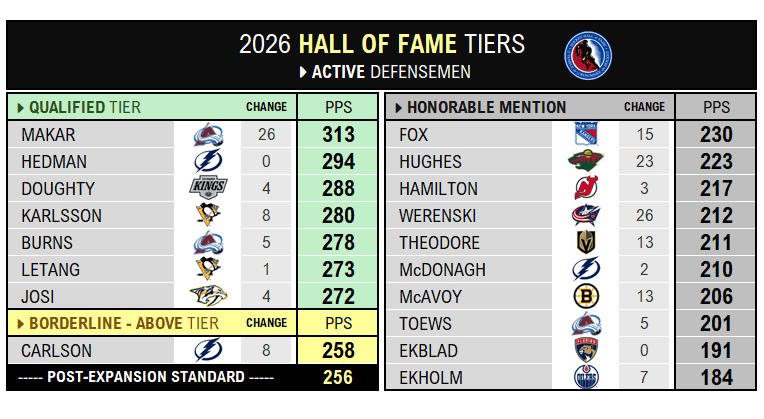
✅ QUALIFIED TIER (7)
Cale Makar, Colorado, 27: Makar is made in a lab for PPS, already within 26 of becoming the ninth post-expansion Inner Circle defender. The Calgary native added Olympic Silver and a fourth 20-goal season, and he earned both a point-per-game and Norris finalist nod for a sixth consecutive time. For perspective, Chris Pronger (four) and Scott Niedermayer (three), both of whom Makar passed in PPS last season, combined for seven Norris finalist spots over 36 total seasons.
Victor Hedman, Tampa Bay, 35: It was a difficult year for Hedman that included just 33 games, an early Olympic exit, and a personal leave of absence that ended his season. A seven-time year-end All-Star and Conn Smythe winner, Hedman is a stone-cold-lock Hall of Famer, one of the very best of his generation.
Drew Doughty, Los Angeles, 36: Doughty is also a first-ballot guy, currently 24th all-time in PPS among defenders. He was an Olympic breakout star at 20 and still made Canada’s Olympic team at 36 — the first time Doughty didn’t win a best-on-best title in five tries.
Erik Karlsson, Pittsburgh, 36: Karlsson turned back the clock again at 35, finishing ninth in Norris voting and adding +7.8 in PPS. The three-time Norris winner is now 10th in points by a blueliner. A no-doubt choice.
Brent Burns, Colorado, 41: Even though he should be, I’m not convinced Burns is viewed as a Hall of Fame slam dunk. PPS is a fan of his career. He’s a Norris winner, will retire top 10 in points at his position, is one of the sport’s biggest characters, has lasted 23 seasons, and he could break the Iron Man record in February. What more are we looking for?
Kris Letang, Pittsburgh, 39: PPS has all day for Letang’s candidacy, placing him a comfortable +17 above the modern standard. Letang’s score of 273 tops five Hall of Fame defensemen elected in the last 12 cycles: Rob Blake (262), Duncan Keith (258), Shea Weber (257), Doug Wilson (252); Kevin Lowe (177). Letang moved inside the top 20 in points by a defenseman in 2025-26, has three Cup rings, and finished top-10 in Norris voting eight times despite an endless array of serious injuries.
Roman Josi, Nashville, 36: The Swiss puck mover glided into the Qualified tier in 2026. Josi had a solid run atop the NHL, winning the Norris Trophy in 2019-20 and adding 96- and 85-point seasons in his early 30s. From Hedman to Josi, this six-pack of qualified blueliners should roll into the Hall in the first half of the 2030s to get the position within screaming distance of a representative split.
⚠️ BORDERLINE / ABOVE TIER (1)
John Carlson, Tampa Bay, 36: An impressive 60 points in 71 games in his age-36 season bumped Carlson up +8.2 in PPS — from below the standard to slightly above it. Carlson hasn’t oozed Hall of Famer but did have a fifth/fourth/second run in Norris voting. Still productive, he’s got career totals that should force a discussion.
🔮 HONORABLE MENTIONS
Adam Fox, New York Rangers, 28,
Quinn Hughes, Minnesota, 26,
Zach Werenski, Columbus Blue Jackets, 29
All three Norris winners are under 30 and climbing. Each is on an excellent early track toward the Hall. More games and elite play are needed given how the position’s standard skews toward long careers.
🔗 LINK: Top 1,000 Defensemen in NHL history at Adjusted Hockey
🥅 GOALTENDERS
For years, goalies had a difficult time getting into the Hall — only seven were elected in the 32 cycles from 1989 to 2020. The Selection Committee has since elected six in five years. Levelling the position’s imbalance was a great call. But the inductions of Mike Vernon (65th in PPS) and Pekka Rinne (73rd), despite both saving goals at rates below league average, have fractured the Hall’s goalie standard. Now, most Vezina or Stanley Cup winners of the last 40 years feel like potential candidates.
PPS preserves a higher standard because it is based on the 18 best eligible goaltenders — not the ones actually inducted. This keeps dicey choices from crashing the standard.
Post-expansion goaltenders inducted: 18
Class of 2026 additions: Carey Price (+14 vs. standard); Pekka Rinne (-42)
Selection Committee accuracy per PPS: 13/18 (72%)
Active goaltenders above standard: 3
💡 PPS FOR GOALTENDERS IN THE MODERN ERA
When PPS was created six years ago, Goals Saved Above Expected (GSAx) was still working its way toward mainstream acceptance. Now that GSAx is the consensus best public stat for goalies over save percentage, it was time for PPS to evolve. Using HockeyStats.com‘s model back to 2007-08, we can more accurately reward goaltenders facing difficult shot quality and penalize ‘system goalies’ in easier environments.
The evolution fundamentally changes PPS for goalies in the last two decades, a necessary improvement. Here are the notable biggest winners based on the shift: Jonathan Quick; Cam Ward; Frederik Andersen; Evgeni Nabokov; Braden Holtby. The biggest losers: Rinne; Andrei Vasilevskiy; Tomas Vokoun; Craig Anderson; Tim Thomas.
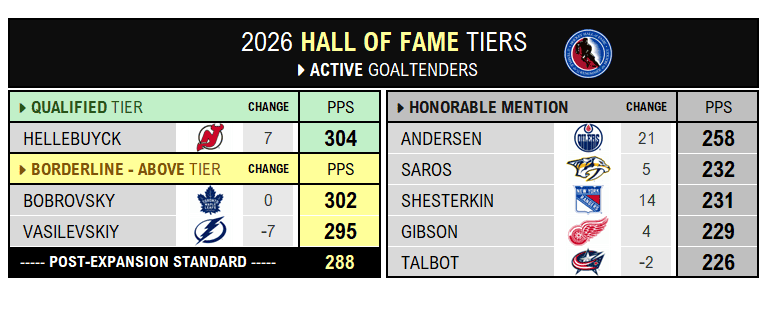
✅ QUALIFIED TIER (1)
Connor Hellebuyck, New Jersey Devils, 33: With three Vezinas and a Hart, Hellebuyck was already in. He finally checked the ‘clutch’ box after his 41-save, heroic performance stole Olympic Gold in February on a global stage. The Inner Circle tier starts at 369 for post-expansion goalies — Patrick Roy, Dominik Hasek, Tony Esposito, Martin Brodeur — so Hellebuyck won’t get there. But he’s now 29th all-time in goalie PPS, and a few more solid seasons will move him into the top 20.
⚠️ BORDERLINE / ABOVE TIER (2)
Sergei Bobrovsky, Toronto, 38: Two Vezinas and two Cups in a long, durable career are plenty for Bob’s future induction. A small haircut from the GSAx adjustment and poor 2025-26 season kept his PPS flat. Even a mediocre season in Toronto will move him to the Qualified tier where he belongs.
Andrei Vasilevskiy, Tampa Bay, 32: Vasilevsky was the second-most negatively affected goalie by the GSAx adjustment given the sweet defensive environment he’s enjoyed in Tampa all these years. But six Vezina finalist nods (and two wins), two Cups, and a Smythe make Big Cat a first-ballot layup. There are no other tiered goalies outside this elite trio.
🔗 LINK: Top 400 Goaltenders in NHL history at Adjusted Hockey
Data from Hockey-Reference; HockeyStats.com